Product Overview
What Is GJFJV Indoor Fiber Optic Cable?
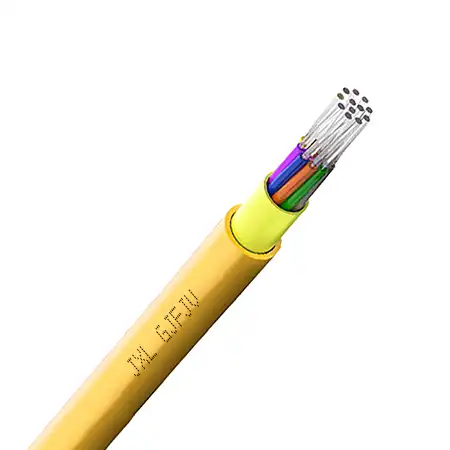
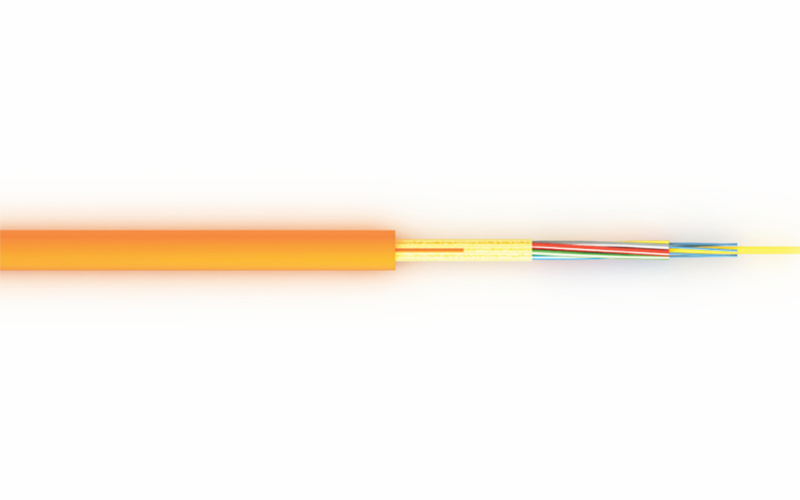
GJFJV is a multi-core tight-buffered indoor fiber optic cable designed for building distribution, equipment rooms, optical distribution frames and indoor backbone connections. Multiple color-coded tight-buffered fibers are reinforced with aramid yarn and protected by a flame-retardant outer jacket.
Unlike loose-tube outdoor cables, the individual tight-buffered fibers inside a GJFJV cable are easier to identify, strip, route and terminate. This makes the cable suitable for indoor installations where compact construction, flexible handling and convenient fiber termination are required.
GJFJV normally identifies the PVC-jacketed version. For projects requiring a low-smoke, zero-halogen outer jacket, the corresponding GJFJH construction can be supplied. Fiber count, fiber type, jacket material, cable color, printing and delivery length can be configured according to the project specification.
GJFJV Cable Construction
| Component | Construction | Purpose |
|---|---|---|
| Optical fiber | OS2, OM1, OM2, OM3 or OM4 | Provides the required single-mode or multimode optical transmission performance. |
| Tight buffer | Color-coded 900 μm tight-buffered fiber | Protects the coated fiber and supports easier identification, stripping and termination. |
| Strength member | Aramid yarn | Improves tensile performance without adding metallic components to the cable. |
| Outer jacket | PVC for GJFJV or LSZH for GJFJH | Provides mechanical protection and the required indoor flame-performance option. |
The cable uses an all-dielectric construction without metallic strength members. Its compact diameter and flexible structure make installation easier in cable trays, risers, conduits, equipment rooms and indoor telecommunications spaces.
Key Features and Benefits
Easy fiber identification: Color-coded tight-buffered fibers simplify routing, termination and maintenance.
Direct termination: The 900 μm tight-buffered fibers can be prepared for connection to optical distribution and termination equipment.
Aramid yarn reinforcement: Non-metallic aramid yarn improves tensile strength while keeping the cable lightweight and flexible.
Compact multi-core construction: Multiple fibers are contained within one round outer jacket, reducing the space required for indoor distribution.
PVC and LSZH options: Jacket construction can be selected according to the building environment and project requirements.
Single-mode and multimode options: Available with OS2, OM1, OM2, OM3 and OM4 optical fibers.
All-dielectric design: The cable contains no metallic strength member and is not affected by electromagnetic interference.
Flexible customization: Fiber count, jacket color, cable marking, delivery length and packing can be produced to order.
Typical Applications
Indoor fiber optic distribution systems
Building backbone and riser cabling
Telecommunications and equipment rooms
Optical distribution frames and fiber termination boxes
Data rooms and enterprise network infrastructure
Connections between communication equipment
Indoor cable trays, conduits and trunking
Factory-terminated fiber assemblies
Patch cord and pigtail production
GJFJV cable is intended primarily for protected indoor environments. Where the route is exposed to water, direct burial, outdoor UV, rodents or higher mechanical loads, an outdoor, indoor-outdoor or armored fiber optic cable should be selected instead.
Fiber Type and Jacket Options
| Fiber Option | Typical Jacket Color | Typical Use |
|---|---|---|
| OS2 G.652D | Yellow | Indoor telecom links, building backbones and long-distance single-mode transmission. |
| OS2 G.657A1/A2 | Yellow | Indoor routes requiring improved bending performance or installation in limited spaces. |
| OM1 62.5/125 μm | Orange | Legacy multimode networks and existing equipment connections. |
| OM2 50/125 μm | Orange | Standard multimode indoor distribution and equipment connections. |
| OM3 50/125 μm | Aqua | High-speed multimode backbone and data communication systems. |
| OM4 50/125 μm | Aqua or violet | Higher-bandwidth multimode links and data center infrastructure. |
Jacket colors are typical industry references and can be customized. The fiber type and printed cable identification should always be confirmed in the purchase specification rather than determined from jacket color alone.
GJFJV and GJFJH Jacket Options
| Cable Designation | Jacket Option | Selection Guidance |
|---|---|---|
| GJFJV | Flame-retardant PVC | Suitable for general indoor cabling where the specified building requirements permit PVC. |
| GJFJH | LSZH low-smoke, zero-halogen material | Used where reduced smoke and halogen emissions are required by the project or installation environment. |
PVC and LSZH should not be treated as interchangeable without checking the installation standard. Please provide the required flame rating, regional standard or project specification when requesting a quotation.
Typical Technical Parameters
| Fiber Count | Reference Cable Diameter | Reference Weight | Long-Term Tensile Load | Short-Term Tensile Load |
|---|---|---|---|---|
| 2 fibers | 4.1 ± 0.25 mm | 12.4 kg/km | 200 N | 660 N |
| 4 fibers | 4.8 ± 0.25 mm | 16.2 kg/km | 200 N | 660 N |
| 6 fibers | 5.1 ± 0.25 mm | 20.0 kg/km | 200 N | 660 N |
| 8 fibers | 5.6 ± 0.25 mm | 26.0 kg/km | 200 N | 660 N |
| 10 fibers | 5.8 ± 0.25 mm | 28.0 kg/km | 200 N | 660 N |
| 12 fibers | 6.2 ± 0.25 mm | 31.5 kg/km | 200 N | 660 N |
| Performance Item | Typical Reference |
|---|---|
| Long-term crush resistance | 300 N/100 mm |
| Short-term crush resistance | 1000 N/100 mm |
| Minimum static bending radius | 10 × cable diameter |
| Minimum dynamic bending radius | 20 × cable diameter |
| Reference temperature range | -40°C to +70°C |
| Standard reference | YD/T 1258.2, IEC 60794-2-10/11 or agreed project standard |
Important: The values above describe a typical construction and are provided for preliminary product selection. Final cable diameter, weight, tensile performance, crush resistance, temperature range and flame rating depend on the selected fiber count, buffer material, jacket material and project standard. The approved datasheet should be used for procurement and installation.
Available Customization
Fiber count: 2, 4, 6, 8, 10, 12 and other configurations up to 24 fibers
Single-mode fiber: G.652D, G.657A1 and G.657A2
Multimode fiber: OM1, OM2, OM3 and OM4
Outer jacket: PVC or LSZH
Jacket color according to fiber type or customer requirement
Sequential meter marking and customized cable printing
Customer brand and OEM identification
Customized reel or drum length
Export packing and wooden drum options
Quality Inspection
Production and inspection are arranged according to the confirmed cable specification. Inspection may include incoming optical fiber verification, attenuation testing, fiber continuity, tight-buffer diameter, cable outer diameter, jacket appearance, cable length, tensile performance, crush performance and finished-product marking.
Additional test reports or project-specific inspections can be discussed before production. Fiber type, jacket material, flame requirement, cable marking and delivery length should be confirmed in the order specification.
How to Specify a GJFJV Indoor Cable
For an accurate quotation, please provide the following information:
Required fiber count
OS2, OM1, OM2, OM3 or OM4 fiber type
PVC or LSZH jacket
Required cable diameter, if specified
Jacket color and printed marking
Required flame or regional compliance standard
Delivery length per reel or drum
Total order quantity
Installation environment and application
If the project specification is incomplete, send the installation environment, fiber count, fiber type and required jacket material. Our team can review the cable construction before production.
Why Source GJFJV Indoor Cable from G&K Fiber Optic?
Integrated fiber optic cable manufacturing and processing resources
20 automated production lines supporting repeatable project output
30,000 m² of production, inspection, warehouse and office space
More than 10 quality inspection and testing items
Daily fiber optic cable production capacity of up to 760,000 meters
Custom fiber, jacket, printing, length and packing options
Technical review for drawings, samples and project specifications
Export-oriented quotation, documentation and packing support
Frequently Asked Questions
What is the difference between GJFJV and GJFJH indoor cables?
Both use a tight-buffered multi-core indoor construction with aramid yarn strength members. GJFJV normally refers to a PVC-jacketed version, while GJFJH refers to an LSZH low-smoke, zero-halogen jacket version. The required jacket should be selected according to the building and project specification.
Is this a simplex or duplex indoor fiber cable?
No. This page describes a multi-core round indoor distribution cable containing several color-coded tight-buffered fibers under one outer jacket. Simplex cable normally contains one fiber, while GJFJBV duplex cable uses two single-fiber units in a flat twin construction.
What fiber counts are available?
Common configurations include 2, 4, 6, 8, 10 and 12 fibers. Other configurations up to 24 fibers can be reviewed according to the required cable diameter, jacket material and production specification.
Can GJFJV cable use both single-mode and multimode fibers?
Yes. It can be produced with OS2 single-mode fibers such as G.652D and G.657A1/A2, or with OM1, OM2, OM3 and OM4 multimode fibers. The selected fiber type should be clearly printed on the cable and confirmed in the order.
Can this cable be terminated directly?
The color-coded tight-buffered fibers are designed for easier handling and termination than bare 250 μm fibers. The exact termination method depends on the connector, enclosure, breakout requirement and installation procedure.
Is GJFJV suitable for outdoor installation?
Standard GJFJV is intended for protected indoor installation. It should not be selected for direct burial, permanent outdoor exposure or wet environments unless a specifically designed indoor-outdoor construction has been confirmed.
Is an LSZH version available?
Yes. A low-smoke, zero-halogen jacket can be supplied as the GJFJH version. The required flame test and regional compliance requirement should be provided before production.
What information is required for a quotation?
Please send the fiber count, fiber type, PVC or LSZH requirement, jacket color, printing, reel length, total quantity and installation environment. A drawing or existing cable specification can also be used for construction matching.
Request a GJFJV Cable Quotation
Send your required fiber count, fiber type, jacket material, cable marking, delivery length and order quantity. G&K Fiber Optic can review standard GJFJV PVC construction, GJFJH LSZH construction and customized indoor distribution cable requirements for your project.