Specifications, compatibility and ordering information
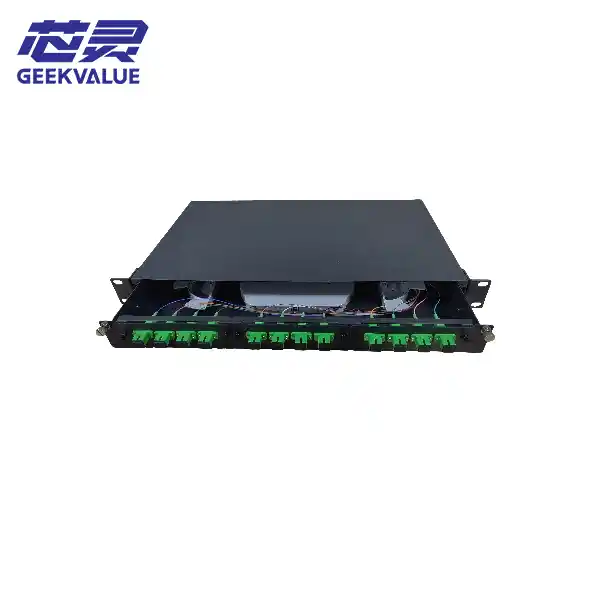
The GPX11X3-3MD 1U High-Density Fiber Patch Panel is a modular rack-mounted platform for fiber termination, patching and high-density cable management in data centers, telecom rooms and optical access networks. Its guide-rail drawer design allows the internal fiber area to be pulled forward for cabling and maintenance while keeping the complete system within a single 19-inch rack unit.
The 1U enclosure supports up to 72 fibers and can accommodate as many as three modular cassettes. The front configuration can be built around LC, SC or MPO/MTP interfaces, allowing the same panel platform to support conventional adapter termination as well as higher-density pre-terminated cabling architectures.
The selected module or adapter-panel arrangement determines how the available 1U space is used. LC panels are available in 12- or 24-fiber formats, SC panels in 8- or 12-fiber formats, while MPO/MTP panels and MPO/MTP-to-LC or SC cassettes support modular high-density links. The panel configuration should therefore be matched to the fiber count, connector system and cabling architecture rather than selected from the 72-fiber maximum alone.
For larger data-center and telecom cabling projects, GPX11X3-3MD panels may be ordered in quantity for installation across multiple racks or equipment rows. Keeping the cassette or adapter-panel configuration, connector interface and fiber layout consistent across the order can simplify rack installation, spare-module planning and later moves, additions and maintenance.
For related high-density cabling assemblies, see our MPO/MTP Cabling System. For broader rack and high-density network deployment, see our Data Center & High-Density Fiber Cabling solutions.
GPX11X3-3MD 1U Patch Panel Specifications
The 72-fiber maximum capacity should be considered together with the selected cassette or adapter-panel format, connector interface and rack cabling architecture.
| Parameter | Specification |
|---|---|
| Model | GPX11X3-3MD-1U |
| Product Type | High-Density Fiber Patch Panel |
| Rack Standard | 19 Inch |
| Rack Height | 1U |
| Structure | Guide-Rail Drawer / Pull-Out Type |
| Maximum Fiber Capacity | 72 Fibers |
| Maximum Cassette Capacity | Up to 3 LGX Cassettes |
| Adapter Interfaces | LC / SC / MPO / MTP |
| LC Panel Options | 12F / 24F |
| SC Panel Options | 8F / 12F |
| Splice Tray Capacity | 12 Fibers per Tray |
| Box Material | Cold-Rolled Steel Plate |
| Dimensions | 483 × 373 × 1U mm |
| Operating Temperature | -40°C to +60°C |
| Storage Temperature | -40°C to +60°C |
| Relative Humidity | ≤85% at +30°C |
| Atmospheric Pressure | 70–106 kPa |
For larger rack deployments, keeping the selected panel or cassette configuration consistent across multiple GPX11X3-3MD units can reduce installation variation and simplify module stocking, expansion and maintenance across the project.