Product Overview
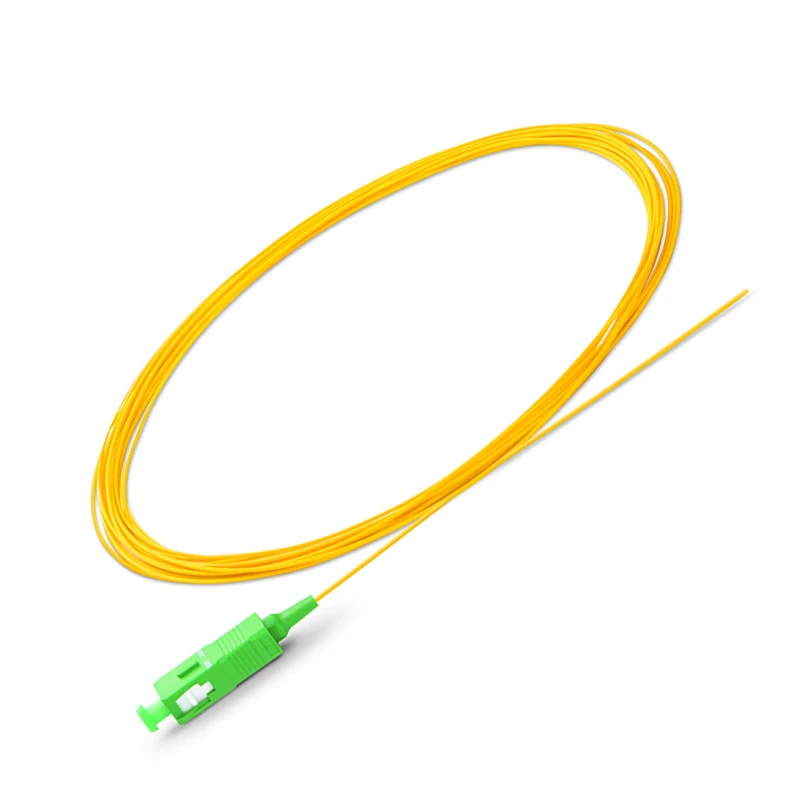
A fiber optic pigtail, often simply called a pigtail, is a fundamental connection device in fiber optic communication networks. You can think of it as a "semi-finished" cable with a pre-installed fiber optic connector at one end and bare fiber optic cable at the other.
If a fiber optic patch cord is a finished cable with "plugs" at both ends, then a pigtail is a specialized component with a "plug" at one end, requiring field wiring at the other. It's primarily used to establish permanent connections between optical cables and equipment.
Core Function: The core function of a fiber optic pigtail is to connect the optical fibers in an optical cable to communication equipment. Its workflow is typically as follows:
* **Termination:** The connector end of the pigtail is directly inserted into the interface of the equipment (such as optical modules or adapters) or patch panel (such as ODF).
* **Sponging:** The bare end of the pigtail is permanently fused to the optical fiber in the trunk cable using a fusion splicer.
* **Termination:** After fusion splicing and protection, the optical fiber in the cable is "extended" to a standard interface through the pigtail, achieving termination of the optical cable and facilitating subsequent patch cord connections and management.
Structure and Composition
A typical fiber optic pigtail consists of three main parts:
Fiber Optic: The main body of the pigtail, used to transmit optical signals. It is usually standard single-mode (9/125μm) or multimode (50/125μm or 62.5/125μm) fiber.
Connector: The plug installed at one end of the pigtail. Common types are the same as patch cords, such as SC, LC, FC, ST, etc.
Sheath: The protective layer surrounding the fiber optic cable. Common materials include PVC, LSZH (Low Smoke Halogen-Free), etc.
Main Classifications and Characteristics
Fiber optic pigtails are classified in a similar way to patch cords, but they have two very distinct characteristics.
By Connector Type: Divided into SC pigtails, LC pigtails, FC pigtails, etc., requiring compatibility with the device port.
By Fiber Mode: Divided into single-mode pigtails (yellow sheath) and multimode pigtails (orange, light blue, etc. sheath), requiring compatibility with the system.
By end-face polishing type: Divided into PC, UPC, and APC. APC end-faces, due to their 8° bevel, offer the best return loss and must be matched to the system; they cannot be used interchangeably.
By cable structure:
Single-core pigtail: The most common type, containing only one optical fiber.
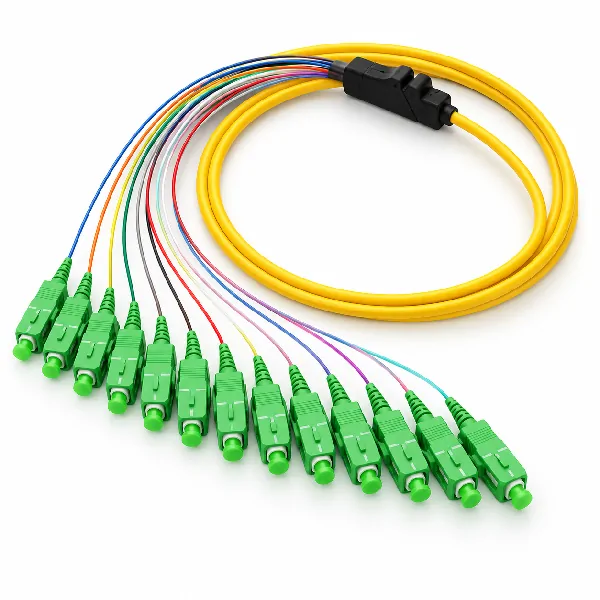
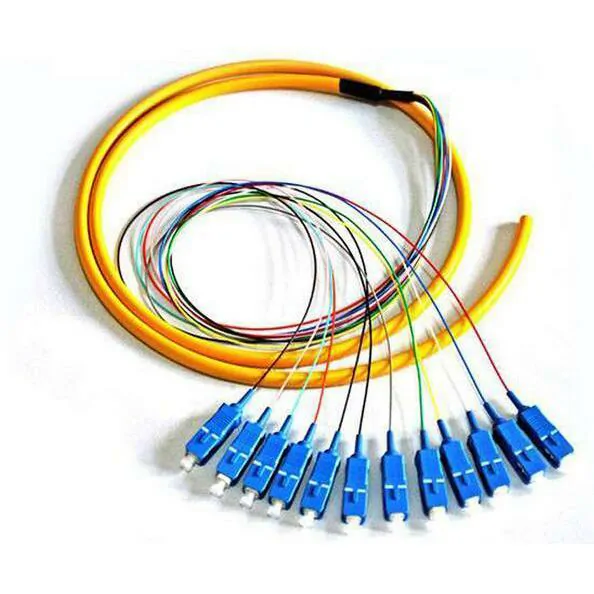
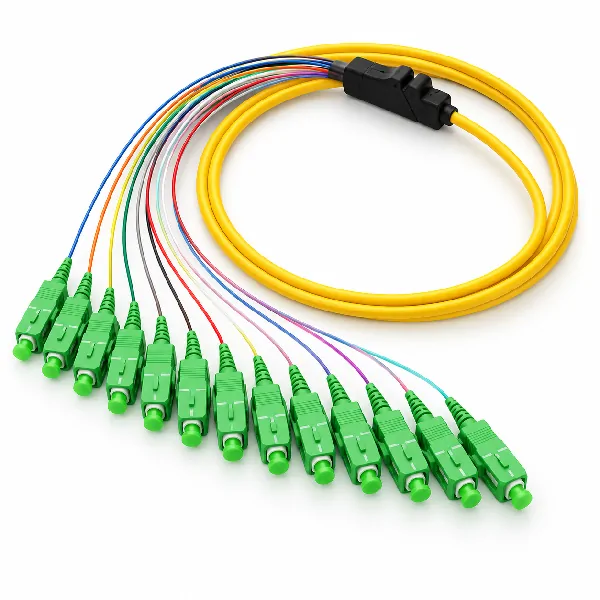
Ribbon pigtail: Combining multiple pigtails (e.g., 4-core, 6-core, 12-core) onto a flat ribbon for high-density connections.
Key differences from patch cords:
Patch cords: Connectors at both ends, "plug-and-play" finished cables.
Pigtails: Connectors only at one end, with bare optical fiber at the other. More of a "semi-finished product," primarily used for splicing termination; once spliced, they are typically not frequently moved.
Key performance indicators: The core parameters for evaluating fiber optic pigtail quality are the same as for patch cords:
Insertion loss (IL): Lower values are better; single-mode typically requires ≤0.3dB.
Return Loss (RL): Higher values are better. UPC endfaces generally require ≥50dB, and APC endfaces ≥60dB.
Repeatability and Durability: After 1000 insertion/removal cycles, performance change should be ≤0.2dB.
Tensile Strength: The change in insertion loss under tensile force.
Operating Temperature: Typically -40℃ to +75℃ (indoor).
Main Applications: Fiber optic pigtails are standard equipment in Fiber to the Home (FTTH) and data center construction; they are used in almost all applications involving fiber optic cable termination.
ODF Fiber Distribution Frame: In data centers, one end of the pigtail is fused to the trunk fiber optic cable, and the other end connects to the adapter on the ODF panel, forming the basis for fiber optic dispatching.
Fiber Optic Terminal Boxes and Splice Boxes: These connect drop or branch fiber optic cables to standard interfaces via pigtails for termination at user terminals or outdoor splicing points.
Fiber optic splice closure: Used for straight-through or branching connections of trunk optical cables, leading out branch optical cables via pigtails.
FTTH/FTTX access: In user corridors or homes, the incoming optical cable is led out via pigtail splicing and then connected to the optical modem (ONU).
Internal equipment: Sometimes also used for optical path connections within devices such as switches and routers.
How to Select and Operate?
Selection Points:
**Matching Interface:** The connector type (SC/LC, etc.) of the pigtail must be compatible with the equipment or adapter.
Matching Fiber Mode: Single-mode systems must use single-mode pigtails, and the same applies to multimode systems.
Matching End Face Type: APC and UPC/PC must not be mixed, otherwise the connector will be damaged. CATV systems typically use APC.
Selecting the Appropriate Sheath: For indoor environments, LSZH sheaths are preferred to ensure safety.
Determining the Core Count and Length: Select single-core or ribbon pigtails as needed. The length should consider the distance from the fiber optic splice point to the equipment interface, and allow for a certain margin.
Key Operation Points:
**Sponge Quality is Crucial:** The exposed end of the pigtail needs to be fused to the fiber optic cable with high quality. Splice loss is a significant component of link loss and should be controlled to ≤0.05dB.
Proper Protection: The splice point must be protected with heat-shrink tubing and properly coiled within the splice spool, ensuring its bending radius meets standards.
Keep it clean: The connector end face is the most delicate part of the optical path and must never be touched by hand. It must be cleaned with specialized tools; otherwise, dust will cause significant losses.
Carefully coil the fiber: When coiling the pigtail inside the box, its bending radius must be greater than 10 times the outer diameter of the sheath to avoid micro-bending losses.
Relevant Standards: The production and inspection of fiber optic pigtails follow the same standard system as patch cords, mainly including:
International Standards: IEC 61300 series, IEC 61754 series, TIA/EIA-568.3-D.
Domestic Standards: YD/T 987, YD/T 1272 series.
Summary: In conclusion, fiber optic pigtails are a crucial "bridge" for achieving permanent "cable-to-equipment" connections in fiber optic communication networks. One end is "rooted" in the optical cable through fusion splicing, and the other end "extends" to a standard interface through a connector. It is one of the most basic and widely used components in equipment rooms and FTTH networks. It can be said that wherever there is optical cable termination, there are fiber optic pigtails.