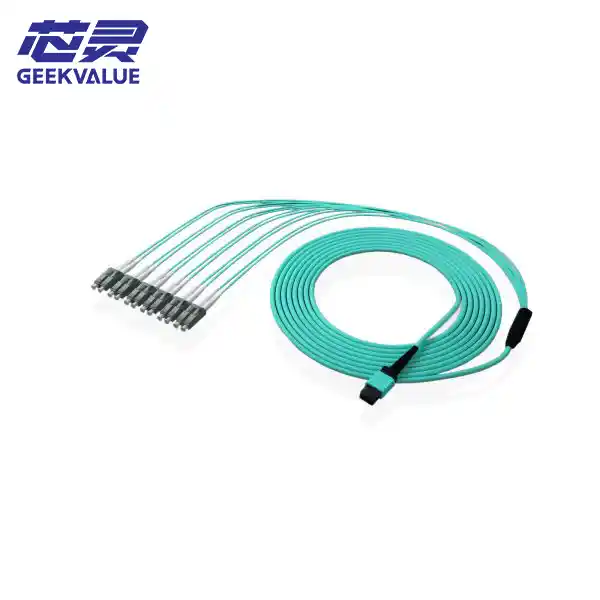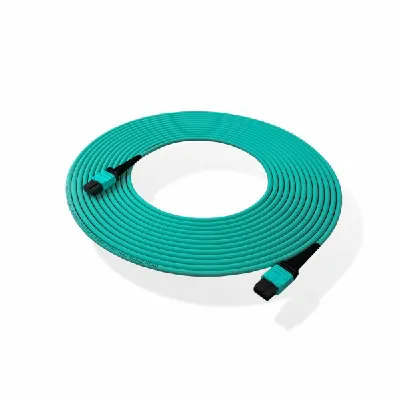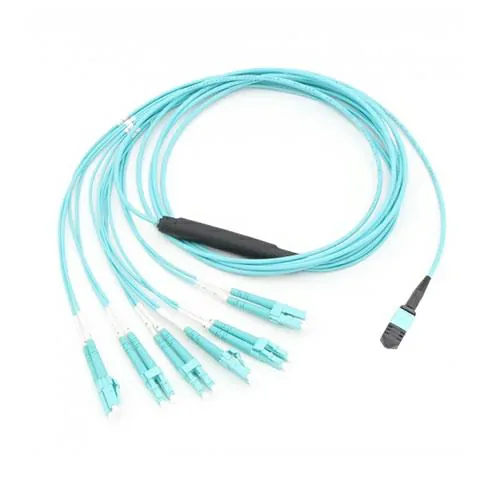
Product Overview
MPO/MTP high-density cabling systems are advanced fiber optic connectivity solutions designed for the needs of modern high-speed, high-capacity data centers. Its core concept is to upgrade the traditional method of connecting individual optical fibers to connecting 12, 24, or even more fibers simultaneously using a single high-density multi-core connector.
Core Concept: MPO and MTP are not just different names.
MPO (Multi-fiber Push-On): This is the international standard name for "multi-fiber push-in" connectors, developed by NTT Communications of Japan, defining the basic specifications for multi-fiber connectors. It can be considered a universal technical standard.
MTP®: This is a registered trademark of US Conec Corporation of the United States, representing a high-performance MPO connector manufactured by them.
It can be understood as follows: The MTP connector is an "enhanced version" of the MPO standard. It fully complies with the MPO standard and is interoperable, but has undergone several optimizations in design and manufacturing:
Superior Performance: Employing more precise manufacturing tolerances ensures lower insertion loss and higher durability.
Easy Maintenance: Its removable housing frame allows technicians to easily re-grind and polish the core MT ferrule.
More Reliable Connections: Utilizing oval-shaped metal pins, MTP is more durable than the round pins of standard MPO connectors, maintaining high-performance transmission for longer.
Simply put, MTP is a higher-quality, higher-performance MPO connector. In scenarios requiring high density and high performance, MTP is often the superior choice.
Core Advantages: Why MPO/MTP?
Maximized Space Utilization: In a 1U (approximately 4.45 cm) rack space, traditional LC-duplex connections can accommodate a maximum of 144 fiber cores, while MPO/MTP solutions can accommodate up to 864 cores, a density six times greater.
Exponentially Faster Deployment: All MPO/MTP components are pre-terminated and 100% tested in the factory. Field installation is like "plug and play." Connecting 144 fiber cores might take a day using traditional methods, but only minutes with MPO/MTP.
Superior Cable Management: Replacing multiple traditional patch cords with a single MPO/MTP trunk cable significantly reduces the number of cables in the cabinet, optimizes airflow, improves heat dissipation, and reduces the complexity of later maintenance.
Future-Friendly Upgrade Path: MPO/MTP is the standard interface for 40G/100G Ethernet transmission. It supports a smooth evolution to higher speeds such as 400G, 800G, and even 1.6T.
System Composition and Key Components: A complete MPO/MTP high-density cabling system typically includes the following components:
MPO/MTP Trunk Cable: The "backbone" of the system, used for long-distance, high-core-count fiber optic transmission between cabinets or within the server room. It typically employs a more robust circular double-sheath design.
MPO/MTP Module Cassette: The "translator" of the system, located within the patch panel. It "translates" a high-density MPO/MTP interface and fans it out into multiple standard full-duplex interfaces (such as LC, SC), facilitating the connection of existing equipment.
MPO/MTP fiber optic patch cords: The "last 100 meters" of the system, used for direct connections between equipment and patch panels, or between equipment themselves.
MPO/MTP adapters and enclosures: Adapters are used for precise mating of two MPO/MTP connectors; enclosures provide physical protection and cable management.
Key Classifications and Selection Considerations
By number of cores (fiber optic array): Common specifications include 12 cores and 24 cores, but 8-core, 16-core, and 32-core options are also available. A 24-core solution doubles the density compared to a 12-core solution.
By connector polarity (A/B/C type): To ensure correct transmission of optical signals between transmit (Tx) and receive (Rx). Common polarity types include Type A (straight-through), Type B (interleaved), and Type C (paired interleaved).
By male/female connector (Pin/No-Pin): MPO/MTP connectors are divided into male (with pins) and female (without pins). A male and female connector must be used in pairs for connection.
By fiber type: Divided into multimode (mainly used for short-distance transmission within data centers, commonly OM3, OM4, OM5) and single-mode (used for long-distance transmission).
Main application scenarios:
Data center core area: Enables high-density interconnection of servers, switches, and other equipment in areas such as MDA (Main Distribution Area) and HDA (Horizontal Distribution Area).
High-speed Ethernet transmission: The standard transmission interface for 40G/100G/400G and even higher speed Ethernet.
Fiber to the building/home (FTTB/FTTH): Efficiently aggregates and distributes fiber optic cables at optical distribution points in buildings or communities.
Inside optical transceiver equipment: Used for internal optical path connections in devices such as optical splitters and SFP/SFP+ optical modules.
AI and High-Performance Computing (HPC): Perfectly meets the rigorous demands for ultra-high bandwidth and extremely low latency in scenarios such as AI computing clusters and HPC.
Key Standards Compliance
International standards: IEC-61754-7 and TIA/EIA-604-5 (FOCIS 5).
Cabling standards: ISO/IEC 11801 and TIA/EIA-568.3-D.
In summary, by integrating multiple fiber connections into a single interface, MPO/MTP high-density cabling systems overcome the space, speed, and scalability bottlenecks associated with traditional cabling, serving as a core technology for modern data centers and high-speed network infrastructure.