Product Overview
Fiber optic patch cords (also known as jumpers) are the most basic and widely used connection devices in fiber optic communication networks. They can be understood as optical cables pre-installed with fiber optic connectors at both ends, commonly referred to as "pre-fabricated fiber optic cables," used for flexible connections between devices or between devices and fiber optic distribution frames.
Core Function: The main function of fiber optic patch cords is to bridge, transfer, and manage optical signals in fiber optic links. Through factory-prefabricated connectors, they enable quick and reliable "plug-and-play" connections between hardware (such as switches, servers, and optical modules) and infrastructure (such as ODF distribution frames and terminal boxes) in fiber optic networks. They are the most active and commonly used "flexible cables" and "active connections" in fiber optic communication networks.
Structure and Composition: A typical fiber optic patch cord mainly consists of the following three parts:
Fiber Optic: The main body of the patch cord, the core medium used to transmit optical signals. Common types are single-mode (9/125μm) or multimode (50/125μm or 62.5/125μm) fiber.
Connectors: Plugs installed at both ends of the optical fiber, used for quick connection between the fiber and equipment. Common types include SC, LC, FC, ST, MPO/MTP, etc.
Outer Sheath: A protective layer surrounding the optical fiber, providing tensile, compressive, and environmental protection. Common materials include PVC, LSZH (Low Smoke Halogen-Free), PE, etc.
Main Classifications: Fiber optic patch cords come in a wide variety to meet different application scenarios and performance requirements.
By Connector Type: This is the most common classification method, determining which device ports it can be used with.
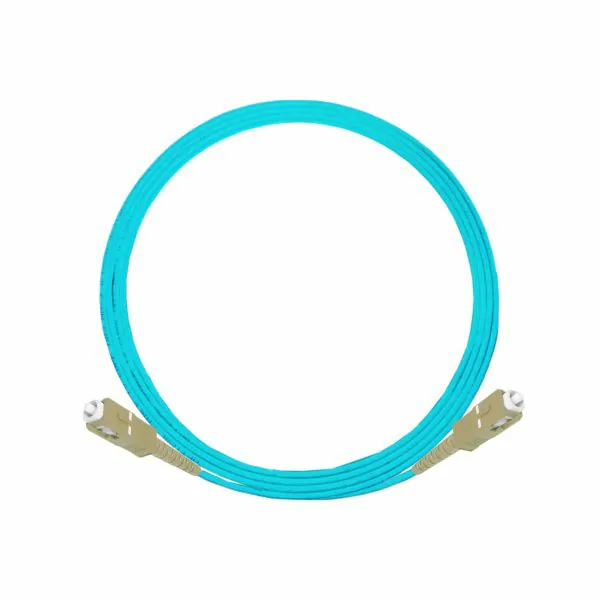
SC Type: Standard square, push-pull locking, one of the most commonly used interfaces in FTTH and enterprise networks.
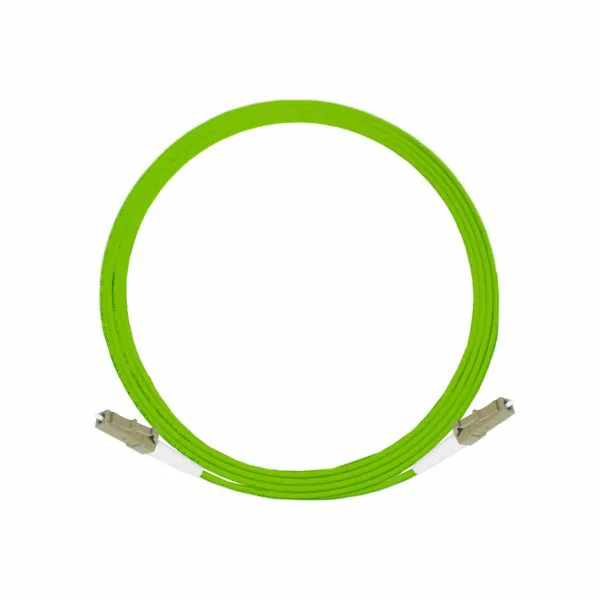
LC Type: Miniaturized square, pluggable, currently the preferred choice for data centers and high-density cabling.
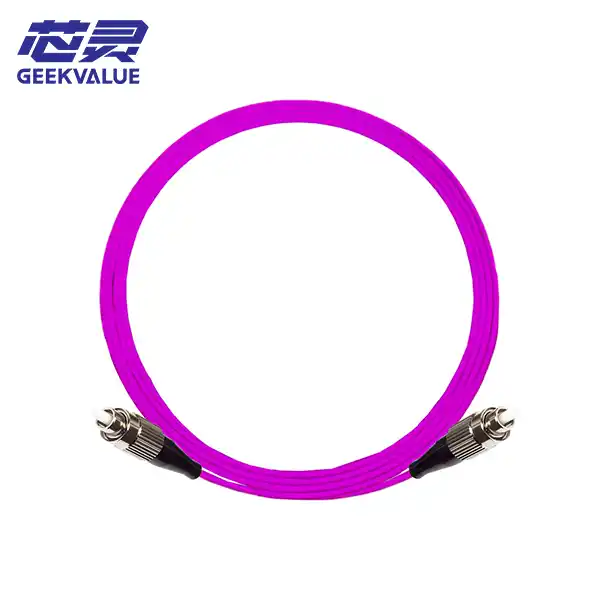
FC Type: Round metal threaded connection, very robust, commonly used in telecommunications and testing scenarios.
ST Type: Round bayonet locking, mostly used in early networks and some multimode applications.MPO/MTP type: Multi-core high-density connector, capable of connecting 12, 24, or even more fiber optic cores at once, standard equipment for high-speed data centers.
By fiber optic mode:
Single-mode patch cord: Typically has a yellow sheath, used for long-distance, high-speed transmission.
Multi-mode patch cord: Sheath colors are mostly orange (OM2), light blue (OM3), purple (OM4), or light green (OM5), used for short-distance transmission in data centers, etc.
By end-face grinding type:
PC (Physical Contact): Physical contact, basic type.
UPC (Ultra Physical Contact): Ultra-physical contact, smoother surface, better return loss performance than PC.
APC (Angled Physical Contact): End face ground with an 8° bevel, optimal return loss performance, commonly used in CATV and FTTx.
By outer sheath material:
PVC (Polyvinyl Chloride): Good flexibility, low cost, but produces toxic fumes when burned.
LSZH (Low Smoke Halogen-Free): Environmentally friendly and flame-retardant, producing little smoke and no toxic gases during combustion, making it the preferred choice for indoor use.
PE (Polyethylene): Good weather resistance and UV resistance, commonly used outdoors.
By Cable Structure:
Single-core/Duplex: The most common patch cord type.
Ribbon/Bundle: Multiple optical fibers are bundled together in a single sheath, used for high-density or special applications.
Key Performance Indicators
Core parameters for evaluating fiber optic patch cord quality include:
Insertion Loss (IL): Power loss of the optical signal after passing through the patch cord; lower values are better. Single-mode patch cords typically require ≤0.3dB, multimode ≤0.5dB.
Return Loss (RL): Power reflected back to the light source; higher values are better. UPC endfaces generally require ≥50dB, APC endfaces ≥60dB.
Repeatability: Consistency of performance after repeated insertion and removal; typically, the change should be ≤0.2dB.
Durability: Mechanical insertion/removal life, standard requirement ≥1000 cycles.
Tensile Strength: The change in insertion loss under tensile force.
Operating Temperature: Typically -40℃ to +75℃ (indoor).
Main Applications: Fiber optic patch cords are fundamental connectors for building any fiber optic network and are virtually ubiquitous.
Data Centers: Extensive use of LC and MPO/MTP patch cords for high-density, high-speed interconnection.
Enterprise Networks: Used to connect switches, routers, servers, and other devices.
Fiber to the Home/Building (FTTx): Enables optical signal access in scenarios such as user terminals and fiber distribution boxes in building corridors.
Cable Television (CATV): Uses patch cords at APC end faces to transmit high
Testing and Measurement: Used as part of the test link in laboratories or on production lines.
Selection and Maintenance
Selection Criteria:
Interface Matching: The patch cord type (SC, LC, etc.) must perfectly match the equipment interfaces and adapters.
Fiber Mode Matching: Single-mode systems require single-mode patch cords; the same applies to multi-mode systems.
End-face Type Matching: APC and UPC/PC end-faces must never be intermixed, as this can damage the connectors.
Application Environment: LSZH jackets are preferred for indoor use, while PE or armored patch cords are required for outdoor or harsh environments.
Length Estimation: Allow for sufficient slack, but avoid excessive length to prevent messy coiling.
Maintenance Recommendations:
Keep Clean: The connector end-face is the most vulnerable part of the patch cord, and contamination is the primary cause of signal attenuation. Clean regularly using specialized tools (such as cleaning pens or lint-free swabs); never use ordinary tissues or touch with bare hands.
Handle with Care: Avoid excessive bending, pulling, or stepping on the cable; ensure the bend radius is no less than 10 times the outer diameter of the jacket.
Proper Management: Use cable organizers and labels to ensure neat cabling and ease of maintenance.
Relevant Standards
The production and inspection of fiber optic patch cords adhere to a series of international and domestic standards, including:
International Standards: IEC 61300, IEC 61754 series, TIA/EIA-568.3-D.
Domestic Standards: YD/T 987, YD/T 1272 series.
Summary
In summary, fiber optic patch cords are the most active and frequently used "flexible connection" components in fiber optic communication networks. Offering "plug-and-play" convenience, they link the various "hard" components of the network and serve as the cornerstone for the flexible deployment, scheduling, and maintenance of fiber optic networks. Selecting the appropriate patch cord type and maintaining it properly are crucial steps in ensuring efficient and stable network operation.