
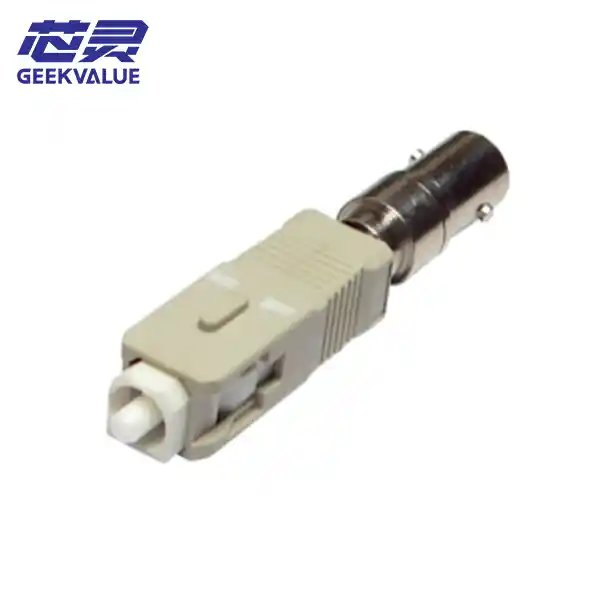
Product Overview
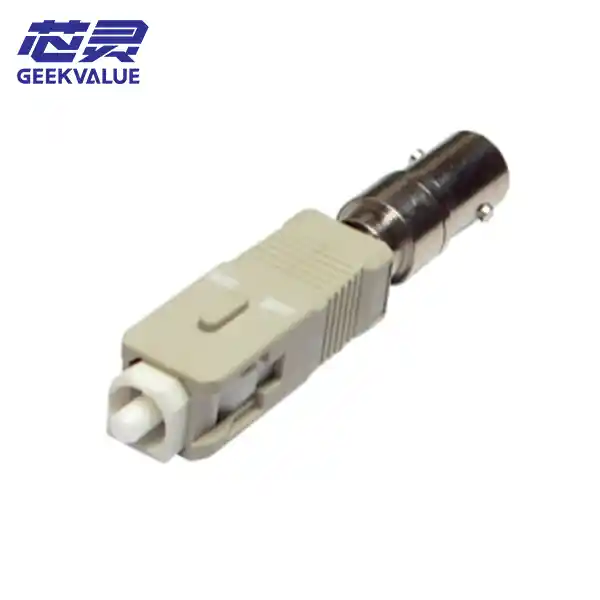 A fiber optic adapter, also called a fiber optic flange or fiber optic coupler, is one of the most basic and critical passive devices in fiber optic communication networks. Its core function is to provide a precise and stable "mating platform" for two fiber optic connectors.
You can think of it as a high-precision "optical path connection tube." It doesn't emit light or process signals; instead, through its precise internal structure, it achieves near-perfect physical alignment of the two fiber cores, minimizing optical signal loss at the connection point.
Core Components and Working Principle
A typical fiber optic adapter mainly consists of the following parts:
Adapter Body: The outer shell used to secure and protect the internal structure.
Alignment Sleeve (Core Component): This is the "heart" of the adapter, usually made of zirconia ceramic. It has a precision opening inside that clamps and guides the ferrules of the two connectors for perfect alignment.
Dust Cap: Used to protect the inner sleeve from dust contamination when not in use.
Its working principle is as follows: when two fiber optic connectors are inserted from both ends of the adapter, the internal ceramic sleeve precisely aligns the ceramic ferrules of both. For highly demanding single-mode fibers, this lateral misalignment needs to be less than 0.5 micrometers (μm).
How to classify?
Fiber optic adapters can be classified in several dimensions to meet different application requirements.
By interface type: This is the most common classification method, determining which connectors it can be used with. Common types are as follows:
Type | Features | Typical Applications
SC | Standard square connector, rectangular shell, uses a plug-in locking mechanism, easy to operate. | Transmission equipment, data communication
LC | Miniaturized (SFF) interface, similar in appearance to SC but smaller, uses a modular jack (RJ) latch. | High-density connections, SFP modules
FC | Circular metal connector, uses a threaded connection, very robust and reliable. | Telecommunications networks, measuring instruments
ST | Circular with a bayonet locking structure, locks after insertion with a half-turn rotation. LAN, Fiber Optic Distribution Frame
MPO/MTP multi-core high-density connection, capable of connecting 12 or 24 fiber optic cores simultaneously. High-speed data centers (40G/100G/400G)
By interface combination at both ends:
* Same type adapter: Interfaces at both ends are the same, such as SC-SC, LC-LC.
* Hybrid adapter: Interfaces at both ends are different, used for conversion, such as LC-SC.
By fiber mode:
* Single-mode adapter: Higher precision, used for single-mode fiber connections.
* Multimode adapter: Used for multimode fiber connections.
By number of ports:
* Simplex: Connects one fiber.
* Duplex: Connects two fibers simultaneously (one for transmitting and one for receiving), the most common form.
By end-face polishing type:
* PC (Physical Contact): Physical contact, the most basic polishing method.
* UPC (Ultra Physical Contact): Ultra-physical contact, better return loss than PC.
APC (Angled Physical Contact): Angled physical contact with end faces ground at an 8° angle, offering optimal return loss performance.
Key Performance Indicators
Evaluating the quality of a fiber optic adapter primarily involves these core parameters:
Insertion Loss: The energy lost by the optical signal after passing through the adapter. Lower values are better. Standard requirements are typically ≤0.2dB, with high-quality products reaching 0.1dB.
Return Loss: The energy reflected back to the light source by the adapter. Higher values are better. APC type adapters typically have the highest return loss, reaching ≥60dB.
Repeatability and Interchangeability: The ability to maintain performance after repeated insertions and removals or replacement of different connectors. Typically, the change should be ≤0.2dB.
Mechanical Durability: The number of insertions and removals it can withstand. Standard requirements are typically ≥1000 cycles.
Application Scenarios
Fiber optic adapters are virtually ubiquitous and are a fundamental component of all fiber optic networks.
Telecommunications Networks: Used in operator data centers and base stations for connecting and scheduling backbone networks, metropolitan area networks, and access networks.
Data Centers: Enables high-density, high-speed optical interconnects between servers and switches.
Fiber to the Home (FTTH/FTTX): Used on fiber optic panels and splitters at the user end.
Cable Television (CATV): Used for fiber optic transmission of television signals.
Testing Instruments: Used with light sources, optical power meters, and other equipment to test fiber optic links.
Summary: In general, fiber optic adapters are the key "bridge" for flexible connectivity and management in optical networks. Although it is just a small, inconspicuous component, its performance directly affects the transmission quality of the entire fiber optic link. Choosing the right, high-quality adapter and performing proper maintenance are fundamental to building a high-speed, stable fiber optic network.